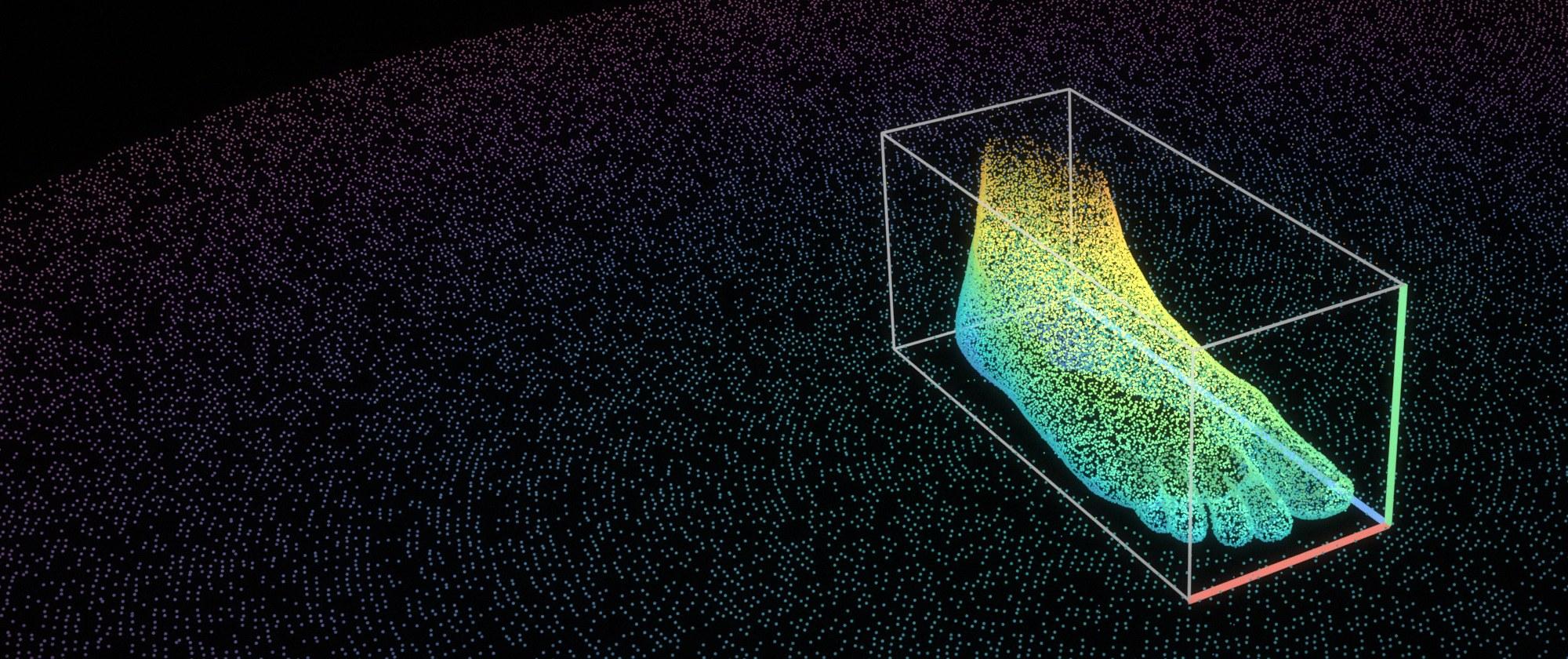
Medical, Orthopedics & Body Scanning
Accurate 3D scans of feet, limbs, faces and bodies from a phone, for orthotics, prosthetics, custom casts, eyewear and made-to-measure clothing.
Laan Labs builds 3D body scanning software for companies that make things to fit a person: orthotics and footwear, prosthetics, custom casts and braces, eyewear, and made-to-measure clothing. A clinician, fitter or the customer scans a foot, a limb, a face or a torso with an iPhone or iPad; the software returns an accurate 3D model and the measurements the product is made from. In one project Laan Labs delivered on-device body-part scanning for custom 3D printed casts, built to the customer's accuracy requirement of plus or minus 2 mm.
Fitting has traditionally meant plaster casts, foam impression boxes, tape measures and calipers, or a dedicated scanner that costs thousands and stays in one clinic. Each is slow, hard to repeat, and requires the person to be in the room. A phone changes that. The front-facing TrueDepth sensor captures fine detail at close range, the rear LiDAR sensor covers larger areas, and ordinary photographs fill in where neither applies, so a scan can be taken in a clinic, a shop or at home, and the shape arrives as data that goes straight into design and manufacturing.
Laan Labs has worked on body-part scanning across feet, limbs, faces and full bodies, and on the computer vision around it, including real-time foot tracking for virtual footwear try-on. Scans of people are sensitive, so these systems are built to reconstruct on the device wherever possible, with nothing uploaded that does not need to be.
How Laan Labs helps
- Foot scanning for orthotics and footwear
- A 3D model of the foot with length, width, arch and instep measurements, for custom insoles and orthotics, orthopedic and made-to-measure footwear, and size recommendation, replacing foam boxes and plaster.
- Limb scans for casts, braces and prosthetics
- Scans of arms, legs and residual limbs detailed enough to design a 3D printed cast, a brace or a prosthetic socket from, captured in minutes without contact and repeatable as the limb changes.
- Face scanning for eyewear
- A detailed scan of the face from the TrueDepth sensor giving pupillary distance, bridge and temple measurements, for custom-fit and 3D printed frames, lens fitting and virtual try-on at true scale.
- Body measurement for clothing
- Body scans and the measurements derived from them, for made-to-measure garments, uniforms, compression wear and size recommendation, without a fitting appointment.
- Guided capture for non-experts
- A capture flow that tells a clinician, a fitter or a patient at home where to move and when the scan is complete, and that checks coverage and quality before the scan is accepted, so a bad scan is caught on the spot and not at manufacturing.
- Automatic landmarks and measurements
- Models that locate anatomical landmarks on the scan and take the same measurements the same way every time, removing the variation between one fitter and the next.
- Design and manufacturing handoff
- Clean, watertight meshes exported as STL, OBJ or PLY, aligned and trimmed to a consistent convention, ready for CAD, 3D printing or milling, and delivered to the order or patient record they belong to.
- On-device processing
- Reconstruction and measurement on the phone or tablet itself, so scans of patients and customers do not have to leave the device or the organization's own systems.
Where to start
A first project is usually one body part and one product, such as feet for insoles or forearms for casts. Laan Labs builds a working capture and measurement prototype in weeks and tests it against the client's current method, whether calipers, casts or a reference scanner, on real people, so accuracy and repeatability are established with numbers before the workflow reaches customers.
The scanning technology can be licensed and built into an existing app, or delivered as a complete white-label app with user management and order workflow. See 3D capture and technology licensing and computer vision and AI development.
Related work
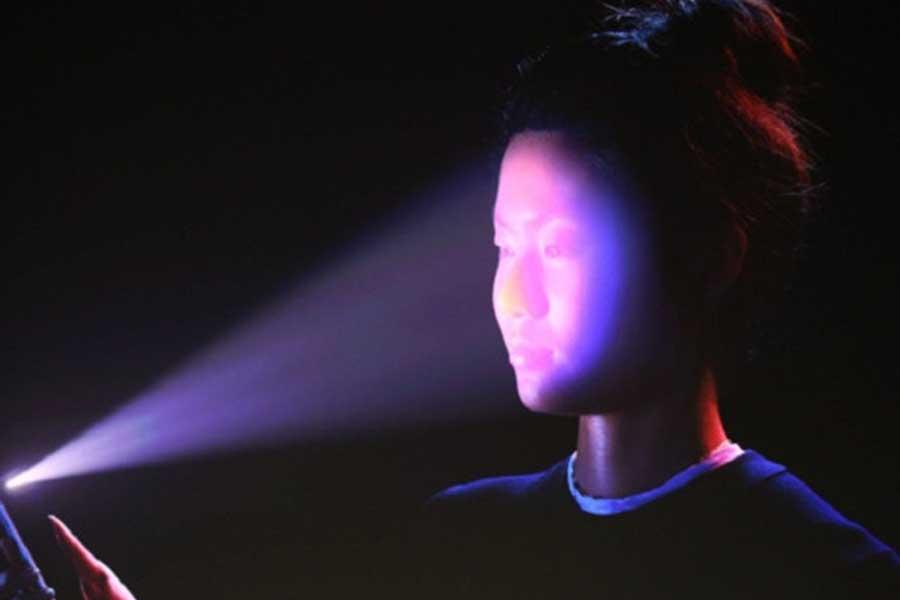
TrueDepth Scanning
Case studies of how our customers are using TrueDepth Scanning
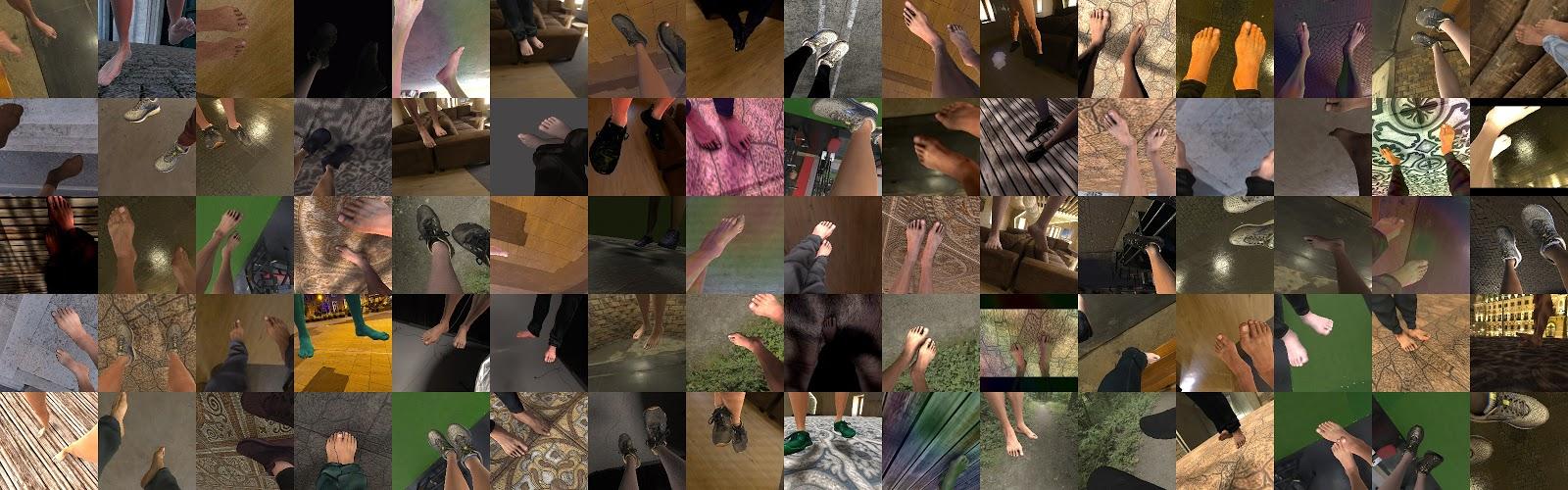
Foot Dataset Generation
Reducing the cost of neural network training for foot pose estimation using Synthetic Data
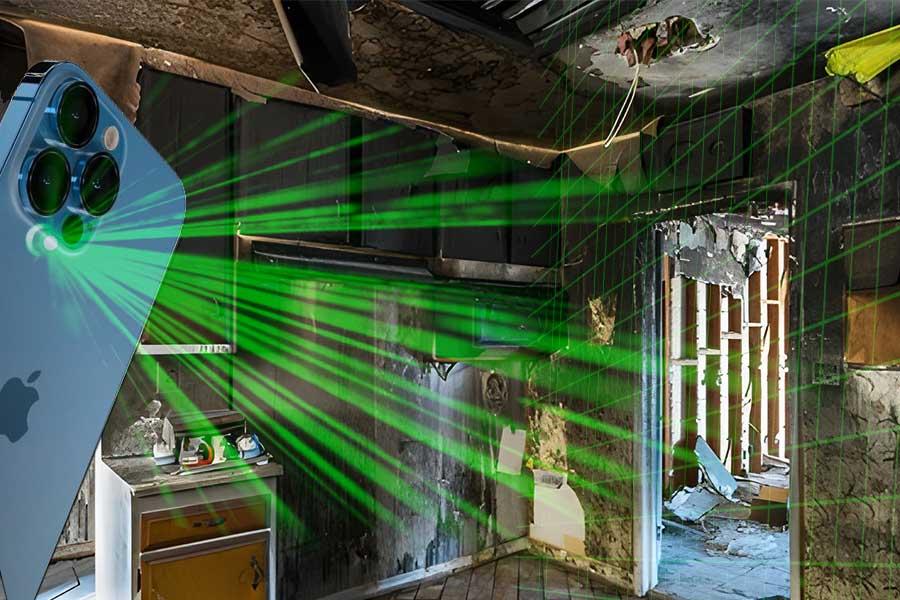
3D Scanner Integration
How Licensing 3D Scanner App Revolutionized An Insurance Company's Workflow

Source Code Licensing
Case study about licensing source code to a startup with a CV/ML team to accelerate their development
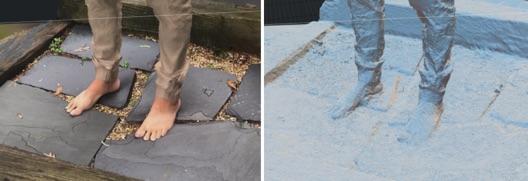
Photogrammetry & Annotation
How to label 1000s of video frames with only a few annotated images
Common questions
How accurate is body scanning with an iPhone?
The iPhone TrueDepth sensor is designed for close-range detail, and millimeter-level results are a realistic target for body parts. Laan Labs delivered a system for custom 3D printed casts whose design target was plus or minus 2 mm, reconstructed on the device. The accuracy achieved in practice depends on the body part, the sensor and how the scan is taken, so each project is validated against the client's own reference method.
Which sensor is used: TrueDepth, LiDAR or the camera?
TrueDepth, the front-facing infrared sensor, gives the finest detail and suits faces, hands, feet and limbs at close range. LiDAR on the rear of Pro models covers larger areas such as a torso or a full body more quickly at lower detail. Photogrammetry from ordinary photographs works on any phone. Laan Labs chooses, and often combines, these according to the body part and the accuracy the product needs.
Can patients or customers scan themselves at home?
For many body parts, yes, with a guided flow and sometimes a second person holding the phone. Feet and faces are practical to self-scan; limbs are easier with help. The software checks each scan for coverage and quality before accepting it.
Do scans have to be uploaded to the cloud?
No. Laan Labs builds reconstruction to run on the device, which was a requirement of the custom cast project for privacy reasons. Where scans do need to be shared with a clinic or manufacturer, they are encrypted in transit and at rest and sent only to systems the client controls.
Is the scanning software a medical device?
Laan Labs builds the capture, measurement and workflow software. Whether a finished product is regulated as a medical device depends on its intended use and market, and that classification and any clearance sit with the company that brings the product to market. Laan Labs works to the documentation and validation requirements a client's regulatory process sets.
Start a conversation
Tell us about the project and one of the founders will reply. Email labs@laan.com or use the contact form.
Services for this industry: 3D Capture & Licensing, Computer Vision & AI, Rapid Prototyping
Other industries: Insurance & Claims, Real Estate, Robotics & Automation, Utilities & Infrastructure, Aerospace & MRO, Construction & AEC